§ 1
Historical Background: Why the Quantum Mind?
The question of how the physical brain gives rise to subjective experience, the so-called hard problem of consciousness, has resisted every purely classical account. As quantum mechanics matured through the twentieth century, a remarkable idea emerged: perhaps the gap between matter and mind is bridged not by classical neuroscience alone but by the strange nonlocal, coherent, and measurement-sensitive character of quantum physics.
Classical neuroscience models the brain as an electrochemical computer. Neurons fire or remain silent; synapses strengthen or weaken; information propagates as spike trains through networks. Yet this picture, however successful for sensorimotor processing and memory consolidation, leaves entirely unexplained why there is something it is like to be a brain. The explanatory gap between neural correlates and subjective qualia seemed to demand a radically new framework.
The earliest serious proposals appeared in the 1960s and 1970s. Physicist John von Neumann had already noted that quantum measurement requires a conscious observer to "collapse" the wave function, implying a fundamental link between mind and quantum formalism. Eugene Wigner extended this to argue that consciousness must be outside ordinary quantum mechanics. These ideas remained speculative, but they planted the seeds for what would become three major research programmes.
Why Quantum Mechanics Seems Relevant
Several features of quantum mechanics make it attractive as a model for cognition:
- Superposition: A quantum system exists in multiple states simultaneously until measured. Some theorists equate this with the brain's capacity to entertain multiple hypotheses at once.
- Entanglement: Spatially separated quantum systems share correlations with no classical analog. This suggests a mechanism for the binding problem: how disparate neural areas produce unified experience.
- Non-computability: If certain quantum processes are genuinely non-computable (a contested claim), they could explain why human understanding seems to exceed algorithmic machines.
- Decoherence timescale: The central objection is that the warm, wet brain decoheres quantum states in femtoseconds, far too fast for biological function. This remains the sharpest criticism of all quantum-mind theories.
Three giants tackled the quantum brain from radically different angles: Bohm and Hiley from the foundations of physics, Penrose and Hameroff from geometry and biology, and Pribram from the neuroscience of memory.
§ 2
Bohm & Hiley: The Implicate Order and the Quantum Mind
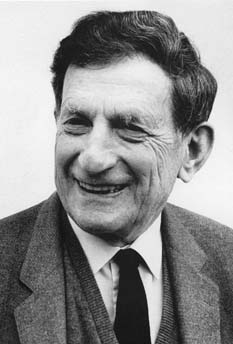
David Bohm (1917–1992) was one of the most original physicists of the twentieth century. Dissatisfied with the Copenhagen interpretation, he reformulated quantum mechanics in 1952 as a deterministic pilot-wave theory. In his later work, especially the 1980 book Wholeness and the Implicate Order, he proposed a far-reaching ontological framework that directly addressed consciousness.
The Implicate and Explicate Orders
Bohm observed that both quantum mechanics and general relativity point toward a deeper, more fundamental level of reality. He called this level the implicate order: an undivided wholeness in which all things are enfolded together, much as the interference pattern on a holographic plate contains the entire image in every region. Our ordinary world, with its separate objects and local causes, is the explicate order, an unfolding from the deeper implicate level.
Mathematically, Bohm expressed the pilot-wave dynamics through a modified Schrodinger equation. A particle of mass $m$ has a real wave function $\psi = R e^{iS/\hbar}$ (polar decomposition). The guidance equation is
$$\mathbf{v} = \frac{\nabla S}{m}$$
and the particle is acted on not only by the classical potential $V$ but also by the quantum potential
$$Q = -\frac{\hbar^2}{2m}\frac{\nabla^2 R}{R} \tag{1}$$
This $Q$ encodes the entire configuration of the environment; it is nonlocal and acts instantaneously. For Bohm, $Q$ is not merely a mathematical artifact; it represents active information, a form of meaningful influence propagating through the implicate order.
Mind, Matter, and the Implicate Order
Bohm proposed that mind and matter are both projections of the implicate order into our explicate realm. Consciousness is not produced by matter; rather, both are complementary aspects of a deeper wholeness. At the implicate level there is no hard boundary between the mental and the physical.
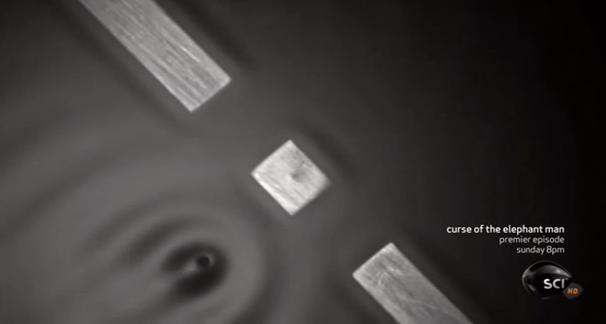
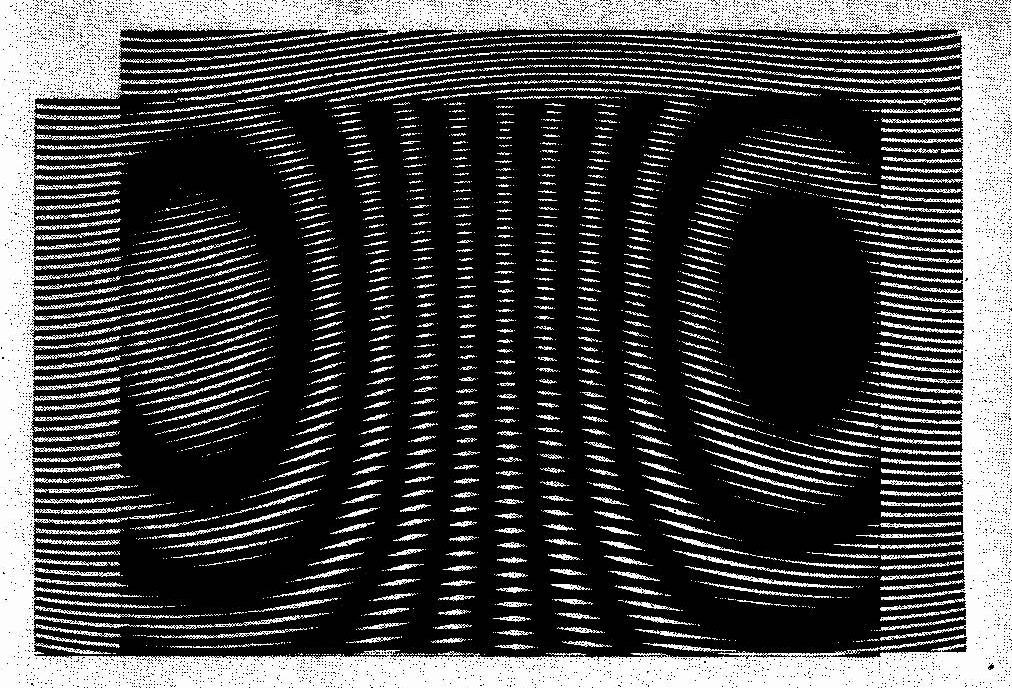
Fig. 1 — Couder's walking-droplet experiment as a pilot-wave analog. A bouncing oil droplet is guided by the surface waves it generates, producing interference-like dynamics reminiscent of de Broglie–Bohm pilot-wave theory.
This has direct consequences for the brain. Bohm suggested that the soma-significant and signa-somatic movements in the brain, the interaction between meaning and bodily process, operate through a kind of active information analogous to the quantum potential. Thought, then, is not merely electrochemical signal but a form of unfolding from the implicate order.
Basil Hiley, Bohm's longtime collaborator, pursued the mathematical foundations rigorously. Hiley developed an algebraic approach based on symplectic and orthogonal Clifford algebras, showing that the Bohm formulation emerges naturally from a non-commutative phase space. In this framework the quantum potential arises as
$$Q = \frac{1}{2m}\left\langle p^2 \right\rangle_W - \frac{1}{2m}\left(\frac{\partial S}{\partial x}\right)^2$$
where $\langle p^2 \rangle_W$ is a Wigner-function moment, making explicit that $Q$ captures quantum fluctuations above the classical guidance. Hiley extended these ideas to propose that the brain's quantum processes operate in an implicate phase space inaccessible to ordinary observation.
Collaboration with Pylkkanen
Philosopher Paavo Pylkkanen developed the Bohm-Hiley framework into a concrete model of cognition. Pylkkanen argued that the physical correlate of logical thinking is at the classically describable synaptic level, while the basic thinking process, raw experience, operates at the quantum-theoretically describable level. This bifurcation mirrors Descartes's mind-body distinction but dissolves it by making both aspects of one implicate reality.
"The implicate order provides a way of seeing that mind is not separate from matter but that the two are different aspects of one underlying reality."
David Bohm, Wholeness and the Implicate Order
Criticisms
The Bohm-Hiley framework is philosophically rich but faces several objections. Bohm never specified a testable neural mechanism through which the implicate order would manifest in brain function. The framework does not predict any deviation from standard quantum mechanics, making empirical discrimination difficult. Critics also point out that pilot-wave theory and standard quantum mechanics give identical observable predictions, so the implicate-order interpretation is not independently testable.
§ 3
Penrose & Hameroff: Orchestrated Objective Reduction (Orch-OR)
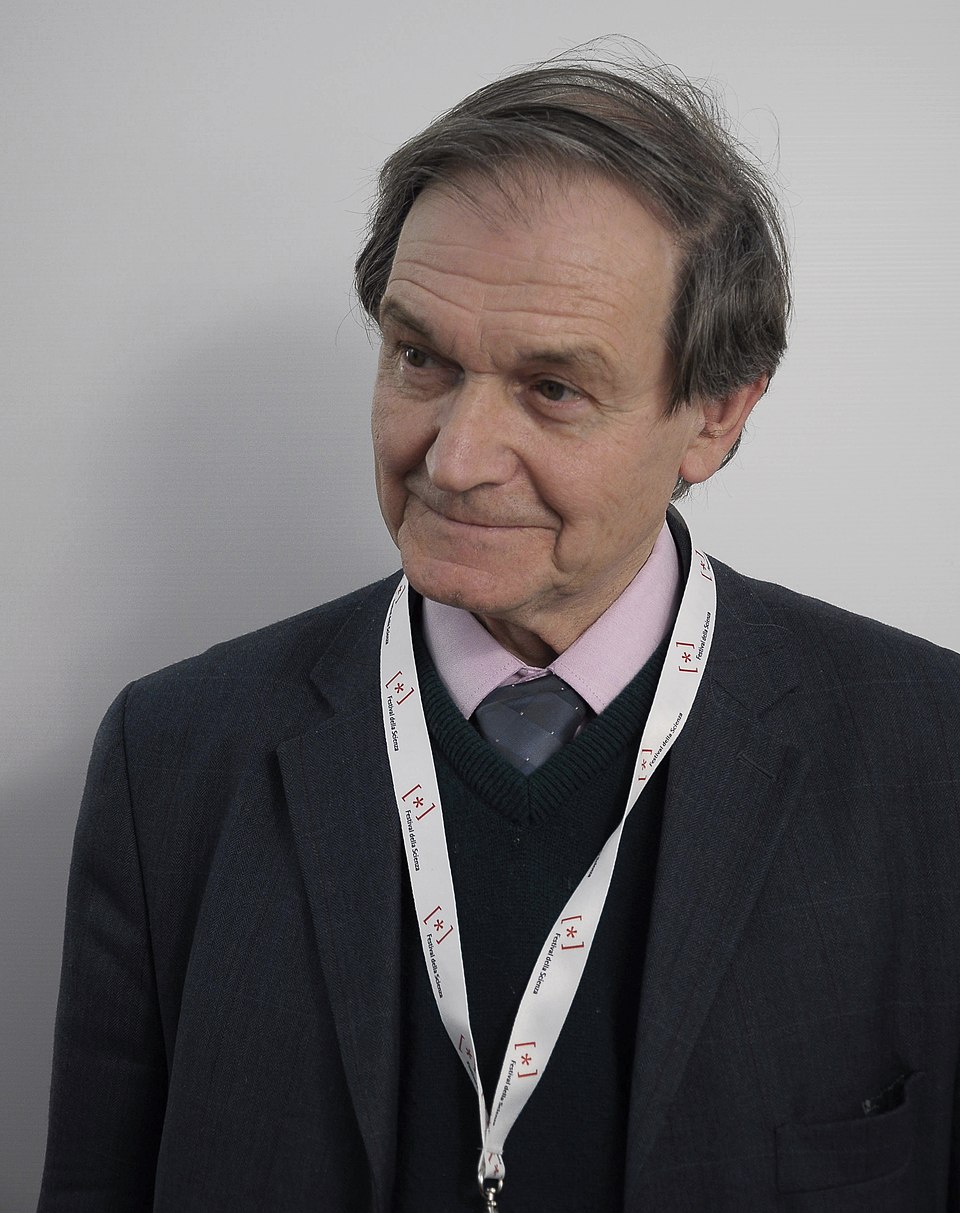
The most mathematically elaborated quantum-mind theory was constructed jointly by mathematician Roger Penrose and anaesthesiologist Stuart Hameroff in the early 1990s. It goes under the name Orchestrated Objective Reduction, or Orch-OR.
Penrose's Godelian Argument
Penrose's starting point is Godel's first incompleteness theorem, which states that any sufficiently powerful consistent formal system $F$ contains a statement $G_F$ that is true but unprovable within $F$. Penrose argued as follows:
- Human mathematicians can recognise the truth of $G_F$.
- No algorithm running on $F$ can recognise $G_F$'s truth from inside $F$.
- Therefore human mathematical understanding is not algorithmic.
- Since the only known source of non-algorithmicity in physics is quantum measurement (wave function collapse), consciousness must involve a non-algorithmic quantum process.
Objective Reduction (OR)
Standard quantum mechanics offers two dynamics: smooth unitary evolution (the Schrodinger equation), and discontinuous collapse upon measurement. Penrose was dissatisfied with both the randomness of Copenhagen collapse and the many-worlds avoidance of it. He proposed a third option: Objective Reduction (OR), a gravitationally induced collapse.
The key idea is that a quantum superposition of two mass distributions corresponds to two distinct spacetime geometries. These geometries diverge at a rate related to the gravitational self-energy $E_G$ of the superposition. Penrose proposed that the superposition is unstable and spontaneously reduces when the uncertainty in spacetime geometry reaches one Planck length $\ell_P = \sqrt{\hbar G / c^3} \approx 1.6 \times 10^{-35}\,\mathrm{m}$. The collapse timescale is
$$\tau \sim \frac{\hbar}{E_G} \tag{2}$$
where $E_G$ is the gravitational self-energy of the superposition, defined as the energy required to displace one mass distribution from the other:
$$E_G = \frac{G}{c^2} \iint \frac{\Delta\rho(\mathbf{r})\,\Delta\rho(\mathbf{r}')}{|\mathbf{r}-\mathbf{r}'|}\, d^3r\, d^3r', \qquad \Delta\rho(\mathbf{r}) = \rho(\mathbf{r})-\rho'(\mathbf{r})$$
This OR process is non-random and non-computable — it is influenced by the structure of spacetime itself, which Penrose links to Platonic mathematical truth. Consciousness, on this view, is the manifestation of OR events.
Hameroff's Microtubules
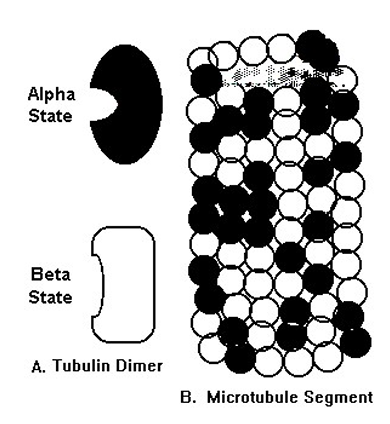
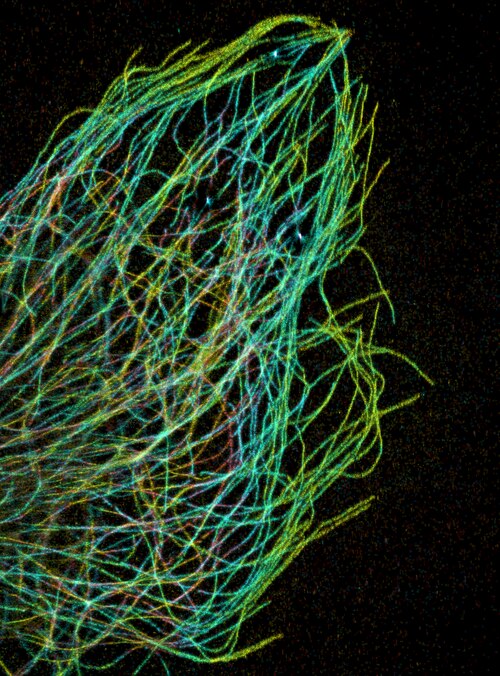
Fig. 2 — Microtubules and tubulin conformational states. Left: $\alpha/\beta$-tubulin dimers with two proposed conformational states that Hameroff suggested could function as quantum-information units. Right: Fluorescence image of the microtubule cytoskeleton inside a eukaryotic cell. Microtubules form hollow cylindrical polymers composed of tubulin dimers and are central to Orch-OR models of quantum cognition.
Penrose's OR needed a biological substrate. Hameroff proposed that microtubules, the protein polymers forming the cytoskeleton of neurons, are ideal candidates. Microtubules are hollow cylinders ($25\,\mathrm{nm}$ outer diameter) assembled from tubulin dimers, each with two conformational states ($\alpha$ and $\beta$) that can encode binary information.
Each tubulin dimer has hydrophobic pockets approximately $8\,\mathrm{nm}$ apart containing delocalized $\pi$-electrons. Hameroff argued these electrons are quantum coherent and can sustain superpositions long enough for biologically relevant OR events. The orchestration of OR by synaptic inputs and biochemical signaling is what makes the process orchestrated, giving the theory its name.
The Orch-OR time estimate uses equation (2). For a microtubule with $N$ tubulin dimers each of mass $m_t \approx 110\,\mathrm{kDa}$ displaced by $d \approx 0.5\,\mathrm{nm}$:
$$E_G \approx \frac{G (N m_t)^2}{d}, \qquad \tau \approx \frac{\hbar d}{G (N m_t)^2} \tag{3}$$
For $N \sim 10^7$ tubulins, $\tau \sim 25\,\mathrm{ms}$, conveniently matching the $\gamma$-band oscillation period associated with conscious binding.
Experimental Evidence and Refutations
Despite the decoherence objection, some experimental observations have been claimed in support:
- Bandyopadhyay (2013): Anirban Bandyopadhyay at NIMS Japan reported quantum vibrations in microtubules at megahertz and gigahertz frequencies, claimed to support Orch-OR.
- Anaesthetic action: Anaesthetics suppress consciousness; Hameroff notes they also disrupt hydrophobic pockets in tubulin. This correlation is suggestive but not conclusive.
- Tuszynski/Alberta (2022): Jack Tuszynski demonstrated that anaesthetics hasten the decay of delayed luminescence in microtubules, a result tentatively linked to superradiance, a quantum optical effect.
- Princeton experiment (2022): Scholes and Kalra used laser excitation to observe prolonged quantum excitation diffusion through tubulin networks, suppressed by anaesthesia.
However, specific structural predictions of Orch-OR have been directly falsified. Kikkawa et al. showed all in vivo microtubules have a B-lattice with a seam, contradicting Hameroff's predicted A-lattice arrangement. De Zeeuw et al. showed dendritic lamellar bodies are micrometres from gap junctions, ruling out Hameroff's proposed coherence pathway to synapses. Italian physicists (2022) found no evidence for gravity-related quantum collapse.
Orch-OR is the most mathematically explicit quantum-mind theory. Whether its audacious combination of Godel, gravity, and biology constitutes deep insight or category error remains one of the sharpest debates in the science of consciousness.
§ 4
Pribram's Holonomic Brain Theory
Karl Pribram (1919–2015) approached the quantum brain from the opposite direction: not from physics downward but from neuroscience upward. A renowned neurosurgeon and psychologist, Pribram was struck by the extraordinary robustness of memory, the ability of brains to retain memories even after large regions are surgically removed, a phenomenon discovered by Karl Lashley in his seminal lesion experiments.
From Holography to the Brain
In 1947 Dennis Gabor invented holography: a method of recording not only the amplitude but also the phase of a light wave, creating an interference pattern on film that encodes the full three-dimensional scene. Crucially, every patch of the holographic plate contains information about the entire image — the information is distributed, not localised.
A holographic plate: every patch contains the whole scene. Pribram identified this distributed storage as the model for biological memory.
Pribram recognized that Lashley's results demanded exactly this kind of distributed storage. Memory traces (engrams) do not reside in specific neural locations; they are spread across neural populations in a hologram-like fashion. By the early 1970s, Pribram had articulated the holonomic brain theory: the proposition that the brain encodes and retrieves information using holographic principles.
The core mathematical object is the Gabor wavelet. Gabor showed that the elementary unit of information storage consistent with the quantum uncertainty principle is a two-dimensional Gabor function:
$$\psi_{a,b}(x) = \frac{1}{\sqrt{a}}\, e^{-\pi\left(\frac{x-b}{a}\right)^2} e^{2\pi i f_0 (x-b)} \tag{4}$$
where $a$ is a scale (spatial frequency bandwidth), $b$ is a location, and $f_0$ is a carrier frequency. Gabor wavelets achieve the minimum product $\Delta x \cdot \Delta k = \frac{1}{4\pi}$, saturating the Heisenberg-like uncertainty relation in the joint space-frequency domain.

Fig. 3 — Gabor wavelet $\psi_{a,b}(x) = a^{-1/2} e^{-\pi((x-b)/a)^2} e^{2\pi i f_0(x-b)}$, the elementary unit of holonomic brain encoding. Top: Real part (blue) with Gaussian envelope (gold dashed). The wavelet achieves the minimum joint localisation $\Delta x \cdot \Delta k = 1/4\pi$, saturating the space-frequency uncertainty relation. Bottom: Imaginary part, phase-shifted by $\pi/2$.
Pribram proposed that dendritic microprocesses in neural tissue implement exactly this transform. The brain, in his view, operates in the spectral domain: it stores the Fourier-like holographic transform of sensory input rather than a pixel-by-pixel map. Perception, memory, and even consciousness arise as the inverse transform, the reconstruction of the world from its holographic representation.
Quantum Field Theory in Dendritic Networks
The explicitly quantum step in Pribram's theory emerged from his analysis of the fine-fibred dendritic web. Dendrites branch into extremely thin filaments (dendritic spines) with diameters of order $0.1\,\mu\mathrm{m}$, far below the scale at which classical electrochemical propagation is reliable. Pribram proposed that information processing at this scale is governed by quantum field theory (QFT), specifically through the Ricciardi-Umezawa model of brain dynamics.
In the Ricciardi-Umezawa framework, the brain is treated as a quantum field. Memory storage corresponds to a phase transition: the field acquires a long-range order parameter $\phi$ through spontaneous symmetry breaking (SSB), much as a ferromagnet acquires magnetisation below the Curie temperature. The Lagrangian governing the cortical quantum field takes the form:
$$\mathcal{L} = \frac{1}{2}(\partial_\mu \phi)^2 - \frac{m^2}{2}\phi^2 - \frac{\lambda}{4!}\phi^4 \tag{5}$$
with the symmetry $\phi \to -\phi$ spontaneously broken when $m^2 < 0$. The resulting Nambu-Goldstone boson, a massless mode with infinite correlation length, is interpreted by Umezawa as the carrier of cortical long-term memory, a quantum of memory dubbed the corticon.
The corticon: a quantum of memory. Beautiful, if true.
Pribram's crucial addition was the identification of the dendritic microstructure as the physical seat of this QFT. Long-term memory, he argued, is encoded as a symmetry-broken vacuum of the dendritic quantum field, and retrieval is the resonant excitation of this vacuum by sensory inputs.
The Binding Problem
One of the most difficult problems in neuroscience is the binding problem: how the brain integrates information processed in anatomically separate cortical regions (V1 for orientation, V4 for color, MT for motion, etc.) into a single unified percept. Pribram argued that his holonomic model solves this problem.
In the holographic framework, binding is automatic: all features of a scene are encoded in the same holographic interference pattern. When the inverse transform reconstructs perception, features are bound by construction — they are all aspects of the same hologram. No explicit binding signal is needed because the spectral domain representation is inherently unified.
Collaboration with Bohm
The deepest synthesis in quantum-mind theory occurred when Pribram and Bohm recognized the complementarity of their frameworks. Bohm's implicate order is, mathematically, a holographic order: the pilot wave $\psi$ enfolds all correlations globally, just as a hologram enfolds the entire scene. Pribram's brain processes information in the frequency domain, which corresponds to the Fourier-transformed (implicate) representation of the external world.
Their joint proposal was that the brain acts as a holographic lens decoding the holographic structure of physical reality: a lens transforming the implicate order into the explicate world of ordinary experience. Conscious perception is thus the intersection of two holographic processes, the implicate structure of the universe (Bohm) and the holographic processing of the brain (Pribram).
"The brain is a hologram enfolded in a holographic universe."
Pribram & Bohm, summarised in Talbot (1991)
Experimental Support
Pribram's holonomic model has a richer experimental base than either Bohm-Hiley or Orch-OR:
- Receptive field tuning: Single-unit recordings in visual cortex (Hubel & Wiesel, and later DeValois et al.) revealed that cortical cells are tuned to spatial frequency bands, matching the Gabor-wavelet decomposition predicted by holonomic theory.
- Lesion tolerance: Lashley's original finding, that memory survives extensive cortical damage, is the foundational experimental motivation for distributed holographic storage.
- EEG phase coherence: Broad-band phase synchronization across cortical areas during memory retrieval is consistent with the global interference patterns of a holographic readout.
- Synaptic microstructure: Electron microscopy reveals dendritic spines with microfilament arrays in the $10$–$100\,\mathrm{nm}$ range, consistent with Pribram's proposed QFT substrate.
The spatial-frequency tuning of cortical neurons remains the most robust experimental finding, though it can also be explained by efficient coding principles without invoking QFT.
Comparing the Three Frameworks
| Theory | Core Claim |
|---|
| Bohm-Hiley |
Mind and matter emerge from the implicate order; the quantum potential carries active information in the brain. |
| Orch-OR |
Microtubule superpositions collapse via objective reduction; collapse events are moments of consciousness. |
| Pribram |
Brain operates as holographic transform of the world; long-term memory is a QFT symmetry-broken vacuum. |
§ 5
Experimental Landscape
All three theories have inspired experimental programmes, with varying degrees of success.
Quantum Coherence in Biology
A landmark finding outside the brain is the observation of long-lived quantum coherence in photosynthetic complexes by Fleming et al. (2007). Oscillatory signals persisting for hundreds of femtoseconds in the Fenna-Matthews-Olson (FMO) complex suggested wavelike energy transfer. Although later reanalysis questioned whether the oscillations are vibrational rather than electronic, the result opened the door to the field of quantum biology and lent credibility to the idea that biological systems can sustain quantum effects at physiological temperatures.
.png)
Fig. 4 — The Fenna-Matthews-Olson (FMO) photosynthetic complex. The FMO complex of green sulfur bacteria contains eight bacteriochlorophyll molecules (coloured) held in a protein scaffold. Fleming et al. (2007) observed oscillatory signals persisting for hundreds of femtoseconds, suggesting wavelike, quantum-coherent energy transfer between pigments.
The Decoherence Problem
Tegmark's 2000 calculation remains the principal challenge to Orch-OR. He modelled a tubulin superposition as two ionic charge configurations separated by $1\,\mathrm{nm}$ in an aqueous environment, obtaining
$$\tau_\phi \sim \frac{\hbar}{\Delta E_{\text{env}}} \approx 10^{-13}\,\mathrm{s} \tag{6}$$
twelve to thirteen orders of magnitude shorter than the timescales needed for Orch-OR ($\sim 10$–$100\,\mathrm{ms}$). Hameroff and Penrose responded by arguing that microtubules may shield their interiors from thermal noise, but no mechanism has been demonstrated.
Quantum Vibrations and Anaesthesia
A series of experiments has attempted to link quantum effects in microtubules to anaesthetic action:
- Bandyopadhyay (2013) reported electrical oscillations in single microtubules at megahertz frequencies, interpreted as quantum resonances.
- Tuszynski (Alberta, 2022) showed that anaesthetics (xenon, isoflurane) accelerate the decay of delayed luminescence, the re-emission of trapped photons in microtubules, implicating quantum optical effects.
- Scholes & Kalra (Princeton, 2022) demonstrated anomalously long excitation diffusion through tubulin networks, suppressed by anaesthetics. They proposed superradiance as a possible mechanism.
Oxford physicist Vlatko Vedral: "the connection with consciousness is a really long shot." Representative of mainstream physics opinion.
Evidence for Holonomic Memory
Pribram's framework enjoys the best empirical footing among the three:
- DeValois et al. (1982) confirmed that cat and monkey cortical neurons are optimally tuned to spatial frequencies, matching the Gabor basis prediction.
- Phase coding, the idea that information is carried in the phase rather than the rate of neural firing, is well-established and consistent with holographic storage.
- Multielectrode recording in rodents during spatial navigation shows phase-amplitude coupling in hippocampal theta oscillations, consistent with a distributed, phase-encoded memory representation.
None of these findings, however, require quantum mechanics per se; they are equally consistent with classical wave mechanics in neural networks.
§ 6
Scientific Reception and Controversy
The reception of quantum-mind theories in the broader scientific community has been overwhelmingly skeptical, though the field retains a committed minority of serious researchers.
Mainstream Neuroscience
The dominant view in computational neuroscience and cognitive science is that quantum effects play no functional role in neural computation. The brain is warm ($37^\circ\mathrm{C}$), wet (mostly water), and structurally disordered, conditions that suppress quantum coherence to timescales far too short to influence synaptic processes, which operate on millisecond timescales. Most neuroscientists regard the brain as a classical information processor and view quantum-mind proposals as motivated more by the desire to resolve the hard problem philosophically than by empirical necessity.
Philosophy of Mind
Philosophers have been more divided. David Chalmers, who coined the "hard problem," is sympathetic to the idea that consciousness may require new physics, but has not endorsed Orch-OR specifically. Patricia Churchland and Daniel Dennett, by contrast, argue that consciousness will ultimately be explained in wholly physical, classical terms, and that invoking quantum mechanics simply relocates the mystery without resolving it.
The Penrose-Godel argument has received particularly sharp criticism. Bringsjord and Xiao (2003) argued that the inference from Godel's theorem to the non-computability of human cognition commits a category error: human mathematicians make mistakes, have finite lifetimes, and cannot actually access the Godelian truth in the way Penrose claims. Turing, anticipating this argument, noted that a sufficiently complex machine might mimic unprovable insight by pure exhaustive search.
Physics Community
Among physicists, the Bohm-Hiley formalism is respectable but its application to consciousness is seen as speculative. Orch-OR's gravitational collapse mechanism is not mainstream; the leading approaches to quantum gravity (string theory, loop quantum gravity) do not predict any Penrose-type collapse on biological timescales.
A 2022 Italian experimental group failed to find any evidence for gravity-related quantum state collapse in well-controlled tabletop experiments using optomechanical oscillators, weakening the empirical case for objective reduction as a physical phenomenon at all.
The Quantum Biology Bridge
The discovery of quantum effects in photosynthesis, avian magnetoreception, and enzyme catalysis has provided an indirect boost to quantum-mind proposals. If evolution has harnessed quantum coherence in protein complexes for energy transfer, it is at least conceivable that similar effects occur in neural proteins. Most quantum biologists, however, sharply distinguish functional quantum effects in metabolism from the specific claims of Orch-OR or the Bohm-Hiley mind framework.
Key Objections Summarised
| Objection | Details |
|---|
| Decoherence |
Brain temperature causes quantum decoherence in $\sim 10^{-13}\,\mathrm{s}$, far too fast for any neural function. |
| Godel Gap |
Penrose's inference from incompleteness to non-computability commits a category error. |
| No Mechanism |
Bohm-Hiley gives no testable neural mechanism; the implicate order makes no unique predictions. |
| Classical Alternatives |
All holonomic brain phenomena can be explained by classical wave mechanics without invoking QFT. |
§ 7
Conclusion
The quantum brain remains one of the most fascinating and contested frontiers in science. Three schools of thought, Bohm and Hiley's implicate order, Penrose and Hameroff's orchestrated objective reduction, and Pribram's holonomic theory, each offer a genuinely novel perspective on the mind-body problem, and each pays a price for its audacity.
Bohm-Hiley is philosophically the most radical: it dissolves the mind-body boundary by situating both in a deeper implicate reality. But it pays the price of near-unfalsifiability and provides no concrete neural mechanism.
Orch-OR is the most mathematically specific: it links Penrose's gravitational threshold to Hameroff's microtubule biology and makes quantitative predictions about consciousness timescales. But its central empirical claim, that microtubule superpositions survive long enough for biological relevance, is contradicted by standard decoherence estimates, and specific structural predictions have been falsified.
Pribram's holonomic theory rests on the firmest experimental ground: the spatial-frequency tuning of cortical neurons is a robust finding, and distributed memory storage is neurally established. The quantum leap to QFT in the dendritic web, while stimulating, remains without direct experimental validation.
What all three share is a recognition that the hard problem of consciousness may not yield to a purely classical, computational description of the brain. Whether quantum mechanics is the missing ingredient or merely a sophisticated metaphor for the brain's complexity remains, for now, gloriously open.
The question is not whether the brain is quantum, but whether any physics we currently possess is adequate to the mystery of what it means to understand, to feel, and to be.
References
[Stapp 1993]H. P. Stapp, Mind, Matter and Quantum Mechanics, Springer, Berlin (1993).
[Penrose 1989]R. Penrose, The Emperor's New Mind, Oxford University Press (1989).
[Chalmers 1995]D. J. Chalmers, Facing up to the problem of consciousness, J. Consciousness Stud. 2, 200–219 (1995).
[von Neumann 1955]J. von Neumann, Mathematical Foundations of Quantum Mechanics, Princeton University Press (1955).
[Wigner 1961]E. P. Wigner, Remarks on the mind-body question, in The Scientist Speculates, Heinemann, London (1961).
[Tegmark 2000]M. Tegmark, Importance of quantum decoherence in brain processes,
Phys. Rev. E 61, 4194–4206 (2000).
doi
[Bohm 1952]D. Bohm, A suggested interpretation of the quantum theory in terms of hidden variables,
Phys. Rev. 85, 166–179 (1952).
doi
[Bohm 1980]D. Bohm, Wholeness and the Implicate Order, Routledge, London (1980).
[Bohm & Hiley 1987]D. Bohm and B. J. Hiley, An ontological basis for the quantum theory,
Phys. Rep. 144, 321–375 (1987).
doi
[Hiley 2001]B. J. Hiley, Non-commutative geometry, the Bohm interpretation and the mind-matter relationship, Proc. CASYS 2000, AIP (2001).
[Pylkkanen 2007]P. Pylkkanen, Mind, Matter and the Implicate Order, Springer, Berlin (2007).
[Penrose 1994]R. Penrose, Shadows of the Mind, Oxford University Press (1994).
[Hameroff & Penrose 1996]S. Hameroff and R. Penrose, Orchestrated reduction of quantum coherence in brain microtubules,
Math. Comput. Simul. 40, 453–480 (1996).
doi
[Godel 1931]K. Godel, Uber formal unentscheidbare Satze der Principia Mathematica, Monatsh. Math. Phys. 38, 173–198 (1931).
[Penrose 1996]R. Penrose, On gravity's role in quantum state reduction,
Gen. Relativ. Gravit. 28, 581–600 (1996).
doi
[Hameroff 1987]S. Hameroff, Ultimate Computing: Biomolecular Consciousness and Nanotechnology, North-Holland (1987).
[Hameroff & Penrose 2014]S. Hameroff and R. Penrose, Consciousness in the universe: a review of the Orch-OR theory,
Phys. Life Rev. 11, 39–78 (2014).
doi
[Donadi et al. 2021]S. Donadi et al., Underground test of gravity-related wave function collapse,
Nat. Phys. 17, 74–78 (2021).
doi
[Scholes & Kalra 2022]A. P. Kalra et al., Electronic energy migration in microtubules, ACS Central Science 9, 701–713 (2023).
[Lashley 1950]K. S. Lashley, In search of the engram, Symp. Soc. Exp. Biol. 4, 454–482 (1950).
[Gabor 1948]D. Gabor, A new microscopic principle,
Nature 161, 777–778 (1948).
doi
[Pribram 1971]K. H. Pribram, Languages of the Brain, Prentice-Hall (1971).
[Pribram 1991]K. H. Pribram, Brain and Perception: Holonomy and Structure in Figural Processing, Erlbaum (1991).
[Ricciardi & Umezawa 1967]L. M. Ricciardi and H. Umezawa, Brain and physics of many-body problems, Kybernetik 4, 44–48 (1967).
[Umezawa 1993]H. Umezawa, Advanced Field Theory: Micro, Macro, and Thermal Physics, AIP (1993).
[DeValois 1982]R. L. DeValois and K. K. DeValois, Spatial vision, Annu. Rev. Psychol. 31, 309–341 (1980).
[Fleming et al. 2007]G. S. Fleming et al., Evidence for wavelike energy transfer through quantum coherence in photosynthetic systems,
Nature 446, 782–786 (2007).
doi
[Cao et al. 2020]J. Cao et al., Quantum biology revisited,
Sci. Adv. 6, eaaz4888 (2020).
doi
[Dennett 1991]D. C. Dennett, Consciousness Explained, Little Brown, Boston (1991).
[Talbot 1991]M. Talbot, The Holographic Universe, Harper Collins, New York (1991).
.jpg)
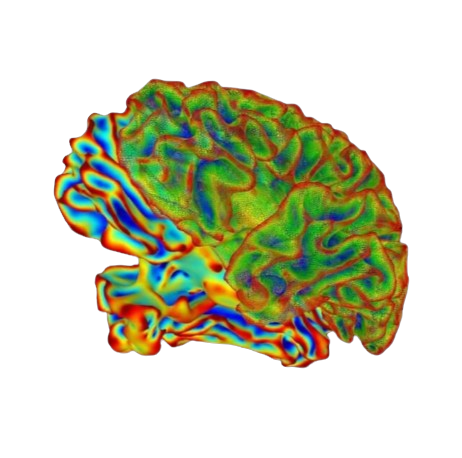
Why does neuronal activity produce experience? A purely computational account explains what the brain does but not what it feels like from the inside. This question drives the quantum mind hypothesis.